
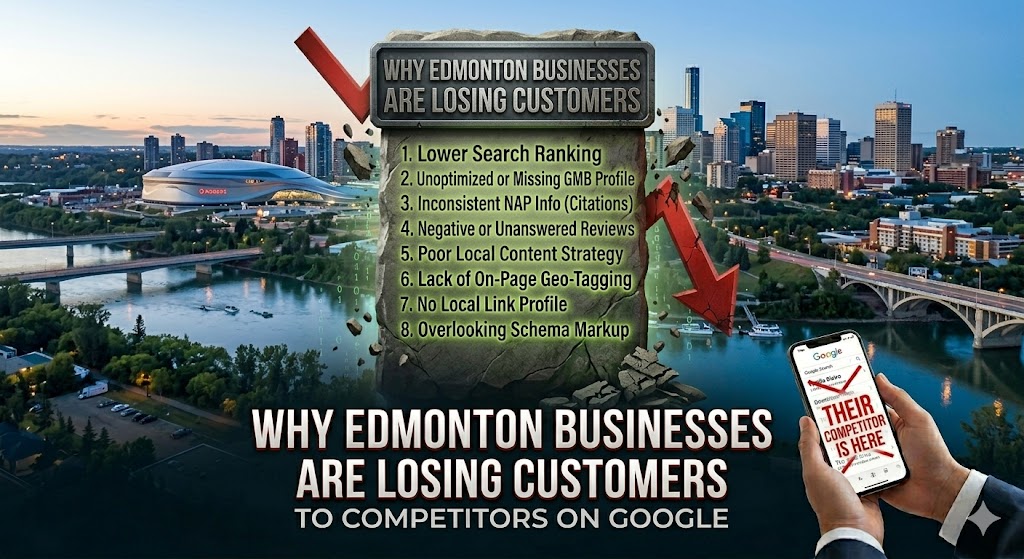
Let’s start with a scenario that’s more common than you’d think. Mark owns a plumbing company in Edmonton. He’s been in the trade for twelve years. His work is solid, his prices are fair, and his existing customers love him. He even paid someone to build him a proper website a couple of years back, with a clean design, a clear phone number right at the top, a list of all the services he offers. By every measure, he should be getting calls.
But his phone is quiet.
Meanwhile, a competitor he’s never heard of — a company half his size, in business for only three years, is booked out for six weeks straight. Same city. Same services. Same target customer.
The difference? That competitor shows up on Google when Edmonton homeowners search for a plumber. Mark doesn’t.
This is the silent crisis facing hundreds of local Edmonton businesses right now. And it has nothing to do with the quality of your work. It has everything to do with local SEO in Edmonton, and whether Google can find you, trust you, and show you to the right people at the right moment.
In this post, we’re going to break down exactly why this happens, what’s causing it, and more importantly, what you can actually do about it.
How Edmonton Customers Actually Search for Local Services
Before we talk about fixing anything, let’s talk about how your future customers behave — because it’s probably not the way you imagine.
Most people don’t go to a company’s website first. They go to Google. They type something like:
- “plumber near me”
- “emergency plumber Edmonton”
- “best HVAC company Edmonton”
- “roofing contractor south Edmonton”
These are what SEO professionals call high-intent local searches. The person typing that isn’t browsing. They need something, often right now, and they’re ready to pick up the phone or book online.
Google’s job — and it’s gotten very good at this — is to show them the most relevant, trustworthy local business for that search. It does that in two main ways:
- The Local Pack: That box near the top of search results showing three businesses on a map. This is prime real estate. Studies consistently show that the majority of local searchers click something in this box — and rarely scroll past it.
- Organic Search Results: The traditional blue links below the map. Ranking here takes more time to build, but it compounds over months and years into a serious competitive advantage.
Here’s the thing about Edmonton specifically: it’s a competitive market in most trades and service categories. Construction, home services, legal, dental, accounting — there are established businesses in every one of those niches. But a large percentage of them still haven’t figured out local SEO. Which means there’s a real window right now to outrank them.
Quick stat worth knowing: “Near me” searches have grown over 500% in the past few years globally, and Edmonton is no exception. If you’re not showing up for those searches, someone else is taking those calls.
The 4 Most Common Reasons Edmonton Businesses Don’t Rank on Google
After helping local Edmonton businesses get found organically, we’ve seen the same problems come up again and again. Here are the four that hurt the most.
1. Their Google Business Profile Is Neglected (or Non-Existent)
Your Google Business Profile (GBP) — formerly Google My Business — is the single most important asset for local search visibility in Edmonton. It’s what populates that map pack. It’s what shows your hours, your photos, your reviews, and your phone number without someone even visiting your site.
And most business owners set it up once, never touch it again, and wonder why it’s not performing.
A weak GBP looks like this:
- No photos, or photos from 2019
- Business category set incorrectly or too broadly
- No Google Posts in the last several months
- Under 10 reviews, with no responses to any of them
- Inconsistent business name or address formatting
Google treats your GBP like a living signal of how active and trustworthy your business is. A neglected profile sends the wrong signal — and you pay for it in rankings.
2. Their Website Has No Local SEO Foundation
Having a website isn’t enough. Your website needs to actually communicate to Google — in clear, structured terms — that you serve Edmonton, what specific services you offer, and where you operate.
Most local Edmonton websites we audit are missing:
- City and neighbourhood references in title tags and headers
- A dedicated service area page or location-specific landing pages
- LocalBusiness schema markup (structured data that tells Google who you are)
- Clear, crawlable contact information with NAP consistency (Name, Address, Phone)
If your website talks about your services but never mentions Edmonton — or worse, has thin, generic content copied from a template — Google has no strong reason to show you to Edmonton searchers.
3. They Have No Local Citations
Local citations are mentions of your business (name, address, phone number) on directories and local listing sites. Think Google, Yelp, Yellow Pages, the BBB, local Edmonton business directories, and industry-specific platforms.
These citations act as trust signals. The more consistent, accurate citations you have, the more Google trusts that your business is real, established, and relevant to the area.
Many Edmonton businesses have almost no citations, or worse — they have a handful of old listings with outdated phone numbers and a different address from when they moved locations two years ago. Inconsistent citations actively hurt rankings.
4. They’re Getting Outreviewed
Reviews matter more than most business owners realize — not just for trust, but as a direct ranking signal in local search. Google looks at:
- The total number of reviews
- Your average rating
- How recently you’ve been getting reviews
- How you respond to reviews (yes, your responses matter)
If a competitor has 80 Google reviews and you have 11, they’re winning that signal even if your actual service is better. Most Edmonton businesses have no process for consistently asking happy customers to leave a review. That’s a fixable problem.
Google Business Profile — The Free Asset Most Edmonton Businesses Ignore
We want to spend a little more time here because optimizing your GBP is genuinely one of the highest-leverage things you can do for local search visibility in Edmonton — and it doesn’t cost you a cent.
Here’s how to actually do it right:
- Choose the right primary category. This is more important than most people think. If you’re a general contractor, don’t just select “Contractor” — get specific. “Kitchen Remodeler,” “Bathroom Remodeler,” or “Home Builder” will target your actual service. You can add multiple categories, but your primary one carries the most weight.
- Fill out every single field. Services, business description, hours, website, phone — all of it. Incomplete profiles rank lower. Use your description to naturally mention Edmonton and your core services.
- Upload real photos regularly. Not stock images. Actual photos of your work, your team, your vehicle, your storefront. Google rewards active profiles. Aim to add new photos at least once or twice a month.
- Post weekly Google Posts. These are short updates that appear on your profile — special offers, seasonal promotions, blog links, project spotlights. Most businesses never use this feature. The ones that do stand out.
- Respond to every review. Good ones and bad ones. Responding shows Google — and potential customers — that you’re engaged and professional. Keep responses warm and genuine. A canned reply is almost worse than no reply.
- Use the Q&A feature. You can actually add your own questions and answers on your profile. Seed it with the most common things customers ask you. It populates your profile with useful content and keeps other people from answering on your behalf inaccurately.
At Mapleleaf, we manage GBP optimization for every client we take on. It’s never an afterthought — it’s one ofthe first things we tackle because the impact is often visible within the first few weeks.
What “Local SEO” Actually Means in Practical Terms
The term gets thrown around a lot, and it can sound technical and intimidating. It doesn’t need to. Here’s what local SEO for an Edmonton business actually involves, in plain language:
On-Page SEO (Your Website’s Foundation)
This is about making sure the pages on your website clearly communicate what you do and where you do it. Practically speaking, that means:
- Every main service page has a unique, descriptive title tag that includes your service and “Edmonton” (e.g., “Residential Electrician Edmonton | Your Company Name”)
- Your H1 heading on each page reinforces that same message
- Your content mentions specific Edmonton neighbourhoods you serve — Windermere, Sherwood Park, St. Albert, Millwoods, etc.
- Your contact page has your full address and an embedded Google Map
- LocalBusiness schema is implemented correctly in your site’s code
Content That Attracts Local Searches
Google loves websites that consistently publish useful, locally relevant content. A blog post answering “how much does it cost to replace a furnace in Edmonton?” or “best time of year to seal your driveway in Alberta” will attract local searchers at the exact moment they’re considering that service.
This isn’t just content for content’s sake. It’s content with a purpose — pulling in organic traffic from Edmontonians who are in the research phase before they hire someone.
Technical SEO (The Behind-the-Scenes Stuff)
Your website also needs to be technically sound. Google will punish a slow, poorly coded, or mobile-unfriendly site regardless of how good your content is. Core things to check:
- Mobile responsiveness — the majority of local searches happen on phones
- Page load speed — slow pages lose rankings and lose customers
- HTTPS security
- Clean, crawlable site structure so Google can index every page
Link Building (Earning Trust Over Time)
When other reputable websites link back to yours — local Edmonton news sites, industry associations, community organizations, other local businesses — it tells Google that your site is trusted and worth ranking. Building these links ethically and consistently is part of a longer-term SEO strategy.
What Consistent Rankings Look Like Over 6–12 Months
We want to be straight with you here, because a lot of digital marketing companies in Edmonton aren’t.
Local SEO is not a switch you flip. It’s a compounding asset you build over time. Here’s a realistic picture of what the timeline looks like for most Edmonton businesses starting from a low-visibility baseline:
Months 1–2: Foundation and Early Signals
This is where the groundwork gets done. GBP optimization. On-page fixes. Citation cleanup. Technical issues resolved. You probably won’t see dramatic ranking movement yet — but you’ll be building the foundation that makes everything else possible. Some early GBP visibility often starts appearing in this window.
Months 3–4: Early Momentum
This is where things start getting interesting. If the foundation work was done properly, you’ll start seeing movement in local pack rankings for some of your target keywords. Website traffic from Edmonton-specific searches begins to tick up. Review volume increases if you’ve implemented a review generation process.
Months 5–6: Compounding Results
By this point, businesses that commit to the process are typically ranking in the local pack for multiple target searches. Phone calls and contact form submissions from organic sources are measurably increasing. Content that was published in months 1–2 is starting to rank and bring in additional search traffic.
Months 7–12: Sustainable Competitive Advantage
A business that’s been executing consistent local SEO for 12 months is in a genuinely strong position. Rankings stabilize and strengthen. The website has accumulated content, links, and authority. The GBP is an active, review-rich profile. At this stage, the compounding effect is real — and maintaining it costs significantly less effort than building it did.
Our founder ranked his own local service business to the top positions in a competitive Edmonton market using only organic SEO — no paid ads, no shortcuts. It took consistency, not tricks. That’s the same approach we bring to every client we work with.
The businesses that give up after two months because they “didn’t see results” are the ones that hand those top spots to competitors who stayed the course. The ones who understand they’re building an asset — not buying a quick fix — are the ones who end up dominating their category.
How This Actually Plays Out: A Quick Story
We started working with a local home services company in Edmonton that was in almost exactly Mark’s situation. Decent website, good reviews from existing customers, zero organic visibility. Their phone was mostly quiet outside of word-of-mouth referrals.
In the first month, we cleaned up their GBP, fixed their on-page SEO, and submitted them to the right local directories with consistent NAP information. We also set up a simple, low-friction review request process for after every job.
By month three, they were showing up in the local pack for several of their core search terms across Edmonton. By month five, their inbound calls from Google had more than doubled. By month eight, they hired an additional crew member to handle the workload.
No ad spend. No gimmicks. Just local SEO done properly, consistently, over time.
That’s what’s possible when the foundation is right.
Frequently Asked Questions: Local SEO for Edmonton Businesses
Q1: How long does local SEO take to show results in Edmonton?
Most businesses start seeing early movement in their Google Business Profile rankings within the first 4–8 weeks of consistent optimization. More competitive search terms and stronger organic rankings typically take 4–6 months of sustained effort. The timeline depends on how competitive your niche is, how much work needs to be done upfront, and how consistently the strategy is executed. Local SEO is a compounding investment — the longer you do it properly, the stronger your position gets.
Q2: Do I really need to spend money on SEO if my business already gets referrals?
Referrals are great — until they slow down. Organic search visibility is what gives you a consistent, predictable stream of new customers that doesn’t depend on who your existing clients happen to mention you to. Many Edmonton businesses that rely entirely on referrals hit a ceiling and can’t grow past it. Local SEO breaks that ceiling and gives you a channel you actually own.
Q3: What’s the difference between local SEO and regular SEO?
Regular SEO aims to rank a website nationally or globally for broad search terms. Local SEO is focused specifically on making your business visible to people searching in a specific geographic area — in this case, Edmonton. It involves unique elements like Google Business Profile optimization, local citation building, review management, and location-specific on-page content. For any business that serves a local customer base, local SEO is almost always the right priority.
Q4: Can’t I just run Google Ads instead?
You can — and for some businesses, Google Ads make sense as a short-term tactic while organic rankings are being built. But ads stop the moment you stop paying. There’s no long-term asset being created. Organic local SEO builds an asset that compounds over time and continues delivering results even if you reduce your investment later. Most Edmonton business owners we speak to have also found that organic results get higher click-through rates than paid ads, because users trust them more.
Q5: How important are Google reviews for local SEO in Edmonton?
Very important. Google uses reviews as a trust and relevance signal when deciding which businesses to show in the local pack. The quantity of reviews, the recency of reviews, your average rating, and how you respond to reviews all factor into your local rankings. Beyond rankings, reviews are also a major conversion signal — a potential customer is much more likely to call you if they see 75 recent, detailed five-star reviews versus 8 reviews from three years ago.
Q6: My website was built a few years ago. Does it need to be redesigned to rank on Google?
Not necessarily redesigned from scratch — but it likely needs some structural and content work. An older website may have slow load speeds, poor mobile responsiveness, missing schema markup, or thin content that doesn’t serve Edmonton-specific search intent. A proper audit will tell you what needs to be fixed. Sometimes the existing site can be improved with targeted changes. Other times, a redesign is worth it both for SEO and for conversion — because showing up on Google is only half the battle. Your site also needs to convert those visitors into actual customers.
Q7: Why choose Mapleleaf over other digital marketing companies in Edmonton?
Fair question. There are a lot of agencies in Edmonton offering SEO services. What’s different about us is that our founder actually used these exact methods to rank his own local service business at the top of competitive search results before we ever took on a client. We know this works because we lived it. We also keep our retainers month-to-month — no long-term contracts, no lock-in. If you’re not seeing results, you’re not stuck with us. That structure keeps us accountable every single month, which is the way we think a genuine business partnership should work.