
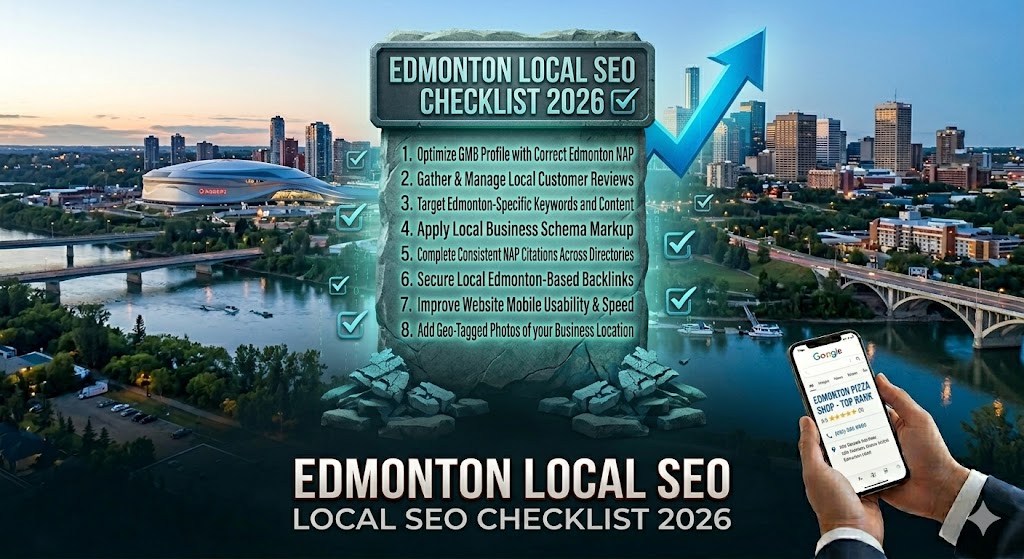
Let’s be honest about something that doesn’t get said enough in the digital marketing world: most Edmonton businesses aren’t failing at SEO because it’s complicated. They’re failing because nobody ever sat down with them and walked through the actual fundamentals — the specific, concrete things that determine whether Google shows your business or your competitor’s when someone nearby searches for what you offer.
This post is that walkthrough.
What you’re about to read is a complete Edmonton local SEO checklist — the same framework we use when we audit a new client’s online presence at Mapleleaf. You can go through it yourself, use it as a conversation guide with your current agency, or hand it to someone on your team as a starting point. Either way, by the end of this, you’ll know exactly where your business stands and what needs to happen next.
We’ve broken it into five sections: your Google Business Profile, your on-page website SEO, technical site health, local citations, and your review generation process. Work through each one and you’ll have a clear picture of what’s holding you back — and what’s worth fixing first.
Let’s get into it.
Google Business Profile Checklist
Your Google Business Profile (GBP) is the foundation of local search visibility in Edmonton. It’s what drives your appearance in the map pack — those three business listings that show up at the top of local search results before anyone even scrolls to the organic links. If you’re not in that box, you’re invisible to a huge portion of potential customers.
The good news: optimizing your GBP costs nothing but time. The bad news: most Edmonton businesses have set it up once and never touched it again. Here’s what a properly optimized profile actually looks like.
Google Business Profile — Checklist
- Claim and verify your listing. If you haven’t done this yet, it’s step one. Go to business.google.com and claim your profile. Unverified listings have almost no ranking power.
- Choose the correct primary category. This is one of the most impactful settings on your entire profile. Your primary category tells Google what type of business you are. Don’t be vague — if you’re a residential electrician, select that specifically, not just “Electrician.” If you’re a family law firm in Edmonton, choose “Family Law Attorney,” not just “Lawyer.”
- Add all relevant secondary categories. You can add multiple categories. A plumbing company might add “Plumber,” “Drainage Service,” and “Water Heater Repair Service” to capture a wider range of search queries.
- Write a keyword-rich business description. Use your 750-character description to explain what you do, who you serve, and where you operate. Mention Edmonton naturally — not stuffed unnaturally, but clearly. This isn’t a major ranking signal on its own, but it reinforces relevance and helps conversion when people read your profile.
- Add your complete and accurate NAP information. Name, Address, Phone number. This needs to match exactly what’s on your website and across all your other directory listings. Even small inconsistencies — “St.” vs “Street,” an old phone number — can dilute your local authority.
- Set accurate business hours — and keep them updated. If you’re closed on Sundays, say so. If your hours change around the holidays, update them. Incorrect hours lead to bad customer experiences and Google will flag inconsistencies.
- Upload real, high-quality photos. Google’s own data shows that businesses with photos receive significantly more direction requests and website clicks than those without. Aim for at least 10–15 photos to start: your storefront or office, your team, your work in progress, finished projects, your vehicle if applicable. Add new photos regularly — at least 2–3 per month.
- Publish Google Posts weekly. Think of these like mini social media posts directly on your Google profile. Promotions, seasonal tips, blog links, project showcases — anything relevant. Most Edmonton businesses never use this feature. The ones that do stand out immediately.
- Use the Products and Services sections. Populate these with your actual offerings, prices where applicable, and descriptions. This gives Google more signals about what you do and makes your profile more useful to potential customers.
- Enable messaging — and actually respond. Google offers a messaging feature so customers can reach you directly from your profile. If you turn it on, respond promptly. Slow response times can actually hurt your profile visibility.
- Answer every question in the Q&A section. Anyone can ask — and answer — questions on your GBP. Don’t leave that to chance. Proactively add the questions you get asked most often and answer them yourself. It populates your profile with useful content and keeps inaccurate answers from strangers showing up.
On-Page SEO Checklist
On-page SEO for Edmonton businesses is about making sure your website speaks Google’s language clearly — telling it what you do, who you serve, and where you’re located, on every page that matters. This is where a lot of Edmonton websites fall flat: they were built to look good, not to rank.
Go through each item below for every main service page on your site.
On-Page SEO — Checklist
- Title tags include your service and location. Your page title is one of the most important on-page ranking signals. It should follow a clear formula: Primary Service + City | Brand Name. For example: “Roof Replacement Edmonton | Smith Roofing” or “Family Lawyer Edmonton | Greenfield Law.” Every main service page needs its own unique, descriptive title tag.
- H1 heading reinforces the title tag. Each page should have one H1 that clearly states what the page is about — and it should include your primary keyword. If your title tag says “HVAC Repair Edmonton,” your H1 might say “Reliable HVAC Repair and Maintenance in Edmonton.” They don’t need to be identical, but they should reinforce each other.
- Meta descriptions are written — and compelling. Meta descriptions don’t directly affect rankings, but they influence click-through rates. A well-written meta description tells the searcher exactly what they’ll find and gives them a reason to click. Keep it under 160 characters and include a light call to action.
- Content mentions Edmonton and specific neighbourhoods. Your service pages should reference Edmonton naturally throughout — and ideally mention the specific areas you serve. If you cover the whole city, reference neighbourhoods like Windermere, St. Albert, Sherwood Park, Leduc, Millwoods, or the Westend where relevant. This signals geographic relevance to Google and resonates with local readers.
- Each main service has its own dedicated page. Don’t lump five services onto one page with a paragraph each. A residential electrician should have separate pages for panel upgrades, EV charger installation, pot light installation, and so on. Each page can rank for its own keyword cluster and captures more specific search traffic.
- Internal linking connects your service pages logically. Your homepage should link to service pages. Service pages should link to related services and your contact page. A clear internal link structure helps Google understand your site’s hierarchy and keeps visitors moving toward conversion.
- LocalBusiness schema markup is implemented. Schema markup is structured data in your website’s code that tells Google explicitly who you are, where you are, what you offer, and how to contact you. For local businesses, this includes your business name, address, phone, service area, and business hours in a format Google can read without guessing. Most Edmonton business websites don’t have this. Adding it is a clear differentiator.
- Contact page includes full NAP and an embedded Google Map. Your contact page should have your exact business name, address, and phone number written out in text — not just an image. Embed a Google Map showing your location. This reinforces your geographic relevance and matches what Google sees in your GBP.
- Content is original, substantial, and locally relevant. Thin pages with 150 words of generic content don’t rank. Google wants pages that genuinely answer a searcher’s question. Aim for at least 400–600 words of original content on each service page — more for competitive keywords. Reference local conditions, local examples, Edmonton-specific context where it makes sense.
- Images have descriptive alt text with local keywords. Every image on your site should have an alt text description. Beyond accessibility, alt text gives Google context for your images. “before-and-after-roof-replacement-edmonton.jpg” and its alt text “roof replacement project in Windermere Edmonton” is infinitely more useful to search engines than “IMG_4823.jpg” with no alt text.
Website Technical SEO Checklist
Here’s where a lot of Edmonton business owners’ eyes glaze over — and understandably so. Technical SEO isn’t glamorous. But it matters enormously. Google won’t rank a slow, broken, or insecure website highly no matter how good your content is. Think of technical SEO as the foundation under everything else.
You don’t need to understand every technical detail — but you do need to know whether these boxes are checked.
Technical SEO — Checklist
- Your website loads fast on mobile. Page speed is a confirmed Google ranking factor — and the threshold has gotten tighter. Use Google’s free PageSpeed Insights tool (pagespeed.web.dev) to test your site. Aim for a score above 70 on mobile. Common culprits for slow sites: unoptimized images, bloated page builders, too many plugins, no caching layer.
- Your site is mobile-responsive. More than half of all local searches happen on mobile phones. If your website looks broken or is difficult to use on a phone, you’re losing customers and rankings simultaneously. Open your website on your phone right now. Does it load properly? Is the text readable without zooming? Are buttons easy to tap? If the answer to any of these is no, that needs to be fixed.
- Your site uses HTTPS (SSL certificate). Google uses HTTPS as a ranking signal and actively flags non-secure sites in browsers. If your website address starts with http:// instead of https://, that’s a problem — and an easy fix your hosting provider or web developer can handle quickly.
- There are no broken links or 404 errors. Broken links create a poor user experience and waste what SEOs call “crawl budget” — the bandwidth Google uses to explore your site. Run a free tool like Screaming Frog or Ahrefs Webmaster Tools to check for broken links and fix or redirect them.
- Google Search Console is set up and verified. Search Console is a free Google tool that shows you how your site is performing in search — what keywords you rank for, what pages Google has indexed, whether there are crawl errors. If you don’t have it set up, you’re flying blind. Set it up and verify your site today.
- Google Analytics (or GA4) is installed. You need to know where your traffic is coming from, which pages people visit, and what they do on your site. GA4 is Google’s current analytics platform. If you don’t have it installed, you have no visibility into whether your SEO work is actually driving results.
- Your site has a clean, crawlable URL structure. URLs should be short, descriptive, and include relevant keywords. “mapleleafedmonton.ca/seo-edmonton” is good. “mapleleafedmonton.ca/page?id=47&ref=XBB” is not. Check that your site’s URL structure is logical and that there’s no duplicate content being created by URL parameters.
- Your site has an XML sitemap submitted to Google. A sitemap is a file that lists all the pages on your website and helps Google discover and index them efficiently. Most CMS platforms (WordPress, Squarespace, Wix) generate one automatically. Make sure it exists and that it’s been submitted in Google Search Console.
- Core Web Vitals are passing. Core Web Vitals are Google’s set of user experience metrics — they measure how fast your page loads, how stable the layout is as it loads, and how quickly it responds to interaction. You can check these in PageSpeed Insights or in Google Search Console under the Experience section. Failing these metrics is a rankings disadvantage.
Quick note from the field: When we audit Edmonton business websites, slow mobile speed and missing SSL certificates are the two technical issues we find most often. Both are fixable — usually within a day or two — and fixing them can have an immediate positive effect on rankings.
Section 4: Local Citations and Directory Listings Checklist
Local citations — mentions of your business name, address, and phone number across the web — are one of the foundational trust signals for local SEO in Edmonton. Google cross-references these mentions to verify that your business is legitimate, established, and located where you say it is.
The goal is consistent, accurate listings across the most authoritative directories — not 500 spammy submissions to irrelevant sites. Quality over quantity.
Local Citations — Checklist
- Google Business Profile is claimed and optimized. (Covered above — but it’s technically your most important citation.)
- Apple Maps listing is claimed and accurate. A significant percentage of mobile searches happen via Apple Maps and Siri. Many Edmonton businesses have never claimed their Apple Maps listing. Go to mapsconnect.apple.com and take care of this.
- Bing Places listing is claimed. Bing holds a small but meaningful share of local searches — especially among older demographics. It takes 10 minutes to set up and it’s worth doing.
- Yelp listing is claimed and populated. Yelp is a significant citation source regardless of how you feel about the platform. Claim it, fill out your profile completely, and respond to any existing reviews.
- Yellow Pages Canada listing is accurate. YellowPages.ca is one of Canada’s most authoritative local directories and a strong citation source for Edmonton businesses. Check that your listing is current.
- Better Business Bureau (BBB) listing exists. BBB accreditation isn’t for everyone, but having a BBB listing — even without accreditation — is a high-authority citation that Google respects.
- Industry-specific directories are covered. This varies by business type. A lawyer should be listed on CanadianLawyers.ca and law society directories. A contractor should be on HomeStars. A dentist should be on RateMDs. A restaurant on OpenTable or SkipTheDishes. Research the top 3–5 directories in your specific industry and make sure you’re listed.
- Edmonton-specific local directories are covered. Look for Edmonton Chamber of Commerce listings, local BIA (Business Improvement Area) directories, and other Edmonton-specific business directories where your business category fits.
- NAP is 100% consistent across all listings. This is critical. Your business name, address, and phone number need to be identical everywhere. If your GBP says “123 Main Street NW” your Yelp listing shouldn’t say “123 Main St.” Run a citation audit — tools like BrightLocal or Whitespark (a great Canadian tool based out of Edmonton, actually) can show you inconsistencies across directories.
- Outdated or duplicate listings are cleaned up. If you’ve moved, changed your phone number, or had someone else create listings on your behalf in the past, there may be old, inaccurate listings floating around. These hurt more than they help. Find them and either correct or remove them.
Review Generation Checklist
Reviews are both a trust signal for potential customers and a direct ranking factor in Google’s local algorithm. The businesses showing up consistently in Edmonton’s local pack almost always have a steady stream of recent, detailed reviews — not just a high rating from five years ago.
Having a process for generating reviews isn’t optional anymore. It’s a competitive necessity. Here’s what that process should look like.
Review Generation — Checklist
- You have a direct Google review link ready to share. Go to your GBP, find the option to share your review link, and save it. Shorten it with a URL shortener if needed. This is the link you’ll share with customers — it takes them directly to the review window with no friction.
- You ask every satisfied customer for a review — consistently. The biggest mistake Edmonton business owners make is asking sporadically. Build the ask into your workflow. After a job is done, after a great appointment, after a positive interaction — that’s when to ask. In person, by text, by email. The best time to ask is when the customer is happiest.
- You send a follow-up text or email with the review link. Most people mean to leave a review and forget. A follow-up message sent within 24–48 hours of service completion — with your direct review link — dramatically increases conversion. Keep it short, genuine, and easy.
- You respond to every single Google review. Good ones, average ones, and negative ones. Responding to positive reviews shows gratitude and personality. Responding to negative reviews professionally shows potential customers that you take issues seriously and handle them with maturity. Google also factors this in.
- You have a strategy for handling negative reviews. Don’t ignore them. Don’t get defensive. Acknowledge the concern, apologize where appropriate, and offer to make it right offline. A well-handled negative review often does more for trust than a five-star review from a stranger.
- You’re generating reviews on platforms beyond Google. Google reviews are the priority, but reviews on Yelp, HomeStars, Facebook, or industry-specific platforms add credibility and contribute to your overall citation footprint. Encourage happy customers to review you wherever they’re most comfortable.
- You track your review count and rating over time. Set a baseline today: how many Google reviews do you have? What’s your average rating? Then track it monthly. Growth here correlates directly with ranking improvement and conversion. If a competitor has 120 reviews and you have 22, that gap is costing you.
One of the first things we implement for new Mapleleaf clients is a simple, systematized review request process. It doesn’t require expensive software — just a clear message, the right timing, and a direct link. Most clients see their review count noticeably increase within the first 60 days.
How Mapleleaf Handles All of This for Edmonton Clients
Going through this checklist probably made one thing clear: there’s a lot of moving parts to local SEO. And the frustrating reality is that neglecting any one of these areas can limit results across all the others. Google’s algorithm looks at the full picture — your GBP, your website, your citations, your reviews — as a combined trust signal.
That’s exactly why we built Mapleleaf the way we did.
Our founder didn’t start this business by studying SEO theory. He used these exact methods — organic local SEO, no paid ads — to rank his own service business at the top of a competitive Edmonton market. When the results were consistent and repeatable enough, starting Mapleleaf was the logical next step.
When we take on a new Edmonton client, we run a full audit across every section of this checklist — GBP, on-page, technical, citations, and reviews — before we do anything else. That audit tells us exactly where the gaps are and what to prioritize for the fastest meaningful improvement.
And because our retainers are month-to-month — no long-term contracts, no lock-in — we stay accountable to you every single month, not just at the signing.
What a Mapleleaf Audit Covers:
- Full Google Business Profile review and optimization roadmap
- On-page SEO analysis of your top 5–10 service pages
- Technical site health review (speed, mobile, Core Web Vitals, indexing)
- Citation audit across 50+ directories with inconsistency report
- Review profile analysis and a recommended generation process
- Competitor comparison — what your top 3 Edmonton competitors are doing that you aren’t
You’ll leave the audit knowing exactly where you stand and what the highest-leverage fixes are. No vague strategy documents. No jargon-filled slide decks. Just a clear, practical plan.
👉 Book Your Free SEO Audit at mapleleafedmonton.ca
Frequently Asked Questions
Q1: Can I do this Edmonton local SEO checklist myself, or do I need to hire someone?
Honestly? You can do a lot of this yourself — especially the GBP optimization, review generation, and basic on-page changes if you have access to your website’s backend. The technical items (schema markup, Core Web Vitals fixes, crawl error cleanup) usually require someone with technical knowledge. The challenge with DIY SEO isn’t knowledge — it’s time and consistency. Local SEO isn’t a one-time task. It’s ongoing. Most Edmonton business owners find they can start the process themselves but benefit significantly from professional support to maintain momentum and keep up with algorithm changes.
Q2: How often should I update my Google Business Profile?
Ideally, every week. At minimum, every two weeks. Publish a Google Post, add a new photo, respond to recent reviews. Google sees an active profile as a more trustworthy and relevant business. Think of your GBP like a plant — it doesn’t need constant attention, but it does need regular watering to stay healthy and grow.
Q3: What is NAP consistency and why does it matter so much for Edmonton SEO?
NAP stands for Name, Address, Phone number. NAP consistency in Edmonton — and everywhere else — means that this information is identical across every place it appears online: your website, your GBP, Yelp, Yellow Pages, industry directories, social profiles, everywhere. Google cross-references these mentions to verify your business is legitimate. Inconsistencies create confusion and erode trust. Something as small as “Avenue” vs “Ave” or an old phone number on an outdated directory listing can dilute your local authority. It seems minor — it’s not.
Q4: How many Google reviews do I need to rank in the Edmonton local pack?
There’s no magic number — it depends entirely on your competition. In some Edmonton niches, you might enter the local pack with 20 solid reviews. In others, competitors have 200+. The key is to be competitive relative to the businesses already ranking in your category. Check your top three competitors in the local pack and note their review counts. That gives you a practical benchmark. Beyond the number, recency matters too. Ten reviews from last month signal more than fifty reviews from three years ago.
Q5: My website is on Wix (or Squarespace, or GoDaddy). Does that limit my SEO potential?
It limits some things, but it doesn’t make good rankings impossible. Platform choice matters less than most people think for local SEO. What matters more is your content, your GBP, your citations, and your technical fundamentals — all of which are achievable on most modern website platforms. That said, WordPress with a well-configured setup gives you more control and flexibility for advanced on-page and technical SEO. If you’re building from scratch, WordPress is generally our recommendation for local Edmonton businesses serious about search visibility.
Q6: How do I know if my current SEO agency is actually doing these things?
Ask them for a monthly report that covers: Google Business Profile activity (posts published, photo additions, review responses), ranking movement for your target keywords, website traffic from organic search in Google Analytics, and citation work completed. If they can’t or won’t provide clear answers to those questions, that’s a problem. A legitimate SEO agency working on local SEO for your Edmonton business should be able to show you exactly what they’ve done and what it’s producing. At Mapleleaf, we report on all of this monthly — no exceptions.
Q7: Is local SEO a one-time fix or an ongoing process?
Ongoing — definitely. Think of it like physical fitness. You don’t go to the gym for three months, get in shape, and then stop and expect to stay that way. Local SEO has a foundation-building phase, where the biggest gains happen quickly, followed by a maintenance and compounding phase, where consistent effort protects and strengthens your rankings over time. Google’s algorithm updates regularly. Competitors don’t stand still. Your GBP needs fresh content. New reviews need responses. Content needs to be added. The businesses that rank consistently in Edmonton are the ones that treat SEO as an ongoing investment, not a one-time project.